
A digital panopticon
UK Home Secretary: "My ultimate vision... that the eyes of the state can be on you at all times"

I noted with interest that journalist Andrew Orlowski, who I featured in this post…

…recently highlighted a quotation from UK Home Secretary Shabana Mahmood, apparently in an interview with Sir Tony Blair (emphasis added):
When I was in justice, my ultimate vision for that part of the criminal justice system was to achieve, by means of AI and technology, what Jeremy Bentham [British philosopher, jurist, and social reformer (1748–1832)] tried to do with his Panopticon. That is that the eyes of the state can be on you at all times.
That interview was featured in this recent Telegraph article:

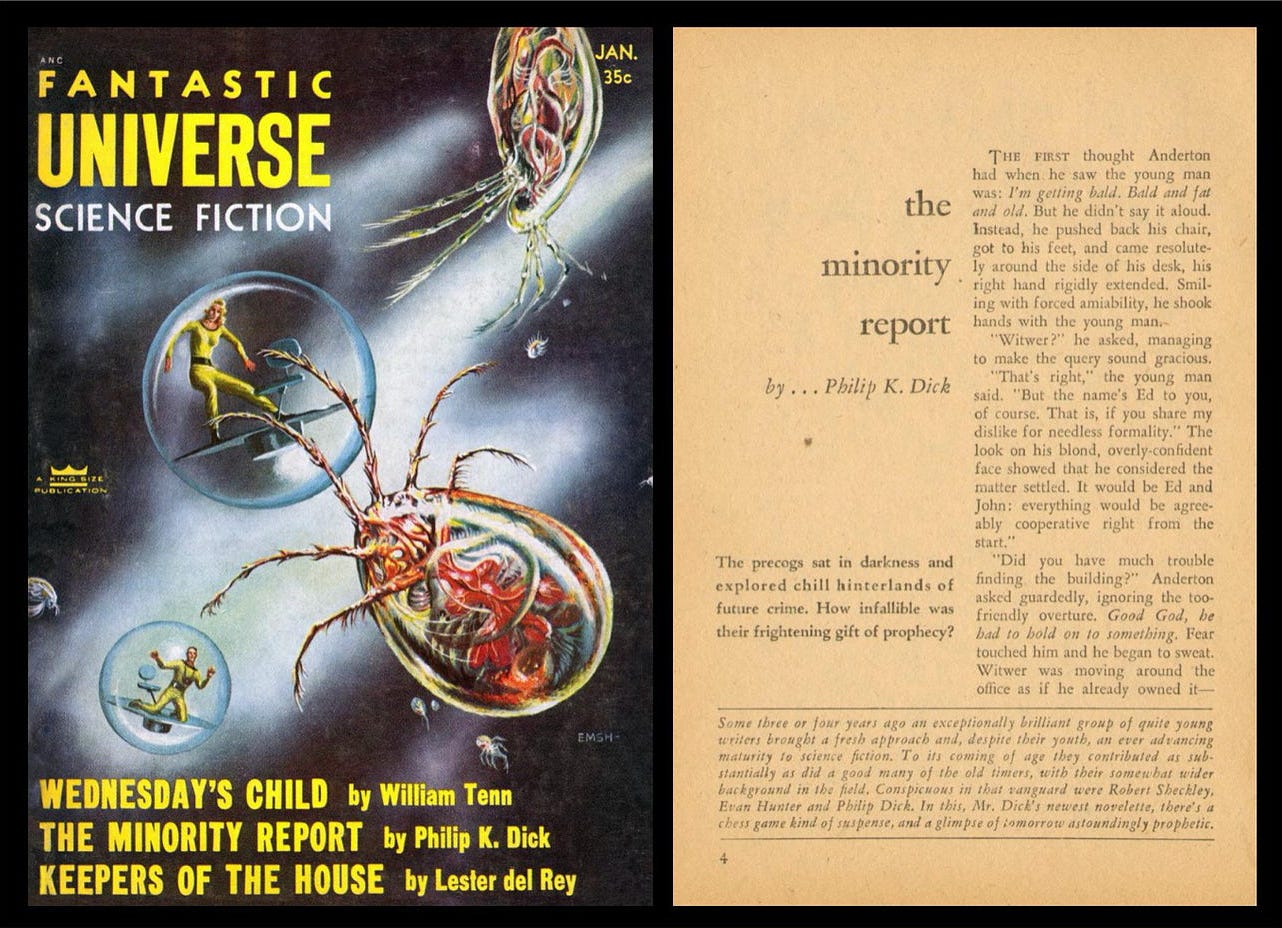
The 2002 film Minority Report is loosely based on this 1956 short story by Philip K Dick:
In relation to the concept of the panopticon, A D M Collingwood, host of the Multipolarity podcast, notes:
For those who do not know, the ‘Panopticon’ [literally ‘all-seeing’] was a plan for a ‘perfect’ prison. The cells were arranged in a [multi-storey] disc around a central guard tower. Because the guards would have a complete view into any of the cells at any time, but the guards in the tower could not be observed from the cells, the inmates would have no idea if they [were] being viewed or not, but [would] know they could be at any time. Therefore, the theory went, they would be forced to act as though they were being viewed.
Ultimately, the psychological effects of such living were considered too cruel for even prisoners to endure, and such a custodial facility was never built. Many indeed consider the entire concept of the Panopticon [to be] the foundation of the theory of totalitarian regimes in operation: if… society [could be arranged] so [that] every citizen [could] be watched at any time but [would not] know whether they [were] being watched… (e.g. the telescreens in Nineteen Eighty-Four’s Oceania), the authorities could force all citizens to act as though they were being watched at any given time.
And this is what our Home Secretary — [who is] in charge of the police and MI5 and the justice system — wants to impose on us. This is her dream society…

I wonder what other things the government might have in mind in terms of preventing crimes — including any behaviour that they define as criminal — before they happen.
As to the Home Secretary, I am reminded of this video clip that I have seen circulating:

I wonder how much truth there is in the notion that they were groomed from a young age for high office in the UK.1
As to the UK government’s plans for digital ID, which would be a big step towards might be described as a digital panopticon, I noted with interest that investigative journalist Lewis Brackpool recently reported that:
We’ve received a tip-off from an internal whistleblower drawing attention to a senior Cabinet Office job advert that sheds light on the government’s Digital ID programme.
The Cabinet Office is recruiting a Deputy Director for Operational Policy, Digital ID, at Senior Civil Service level, to lead the operational delivery of Digital ID across government.
The role is tasked with:
- Progressing key Digital ID use cases
- Working with the Home Office, DSIT and Government Digital Service
- Ensuring technical compliance
- Delivering what the advert describes as a “transformative national capability.”
The position is a temporary 18-month SCS loan, suggesting active programme acceleration rather than long-term embedding.
This advert sits alongside multiple ongoing FOI cases into Digital ID governance, approvals and cross-government coordination.
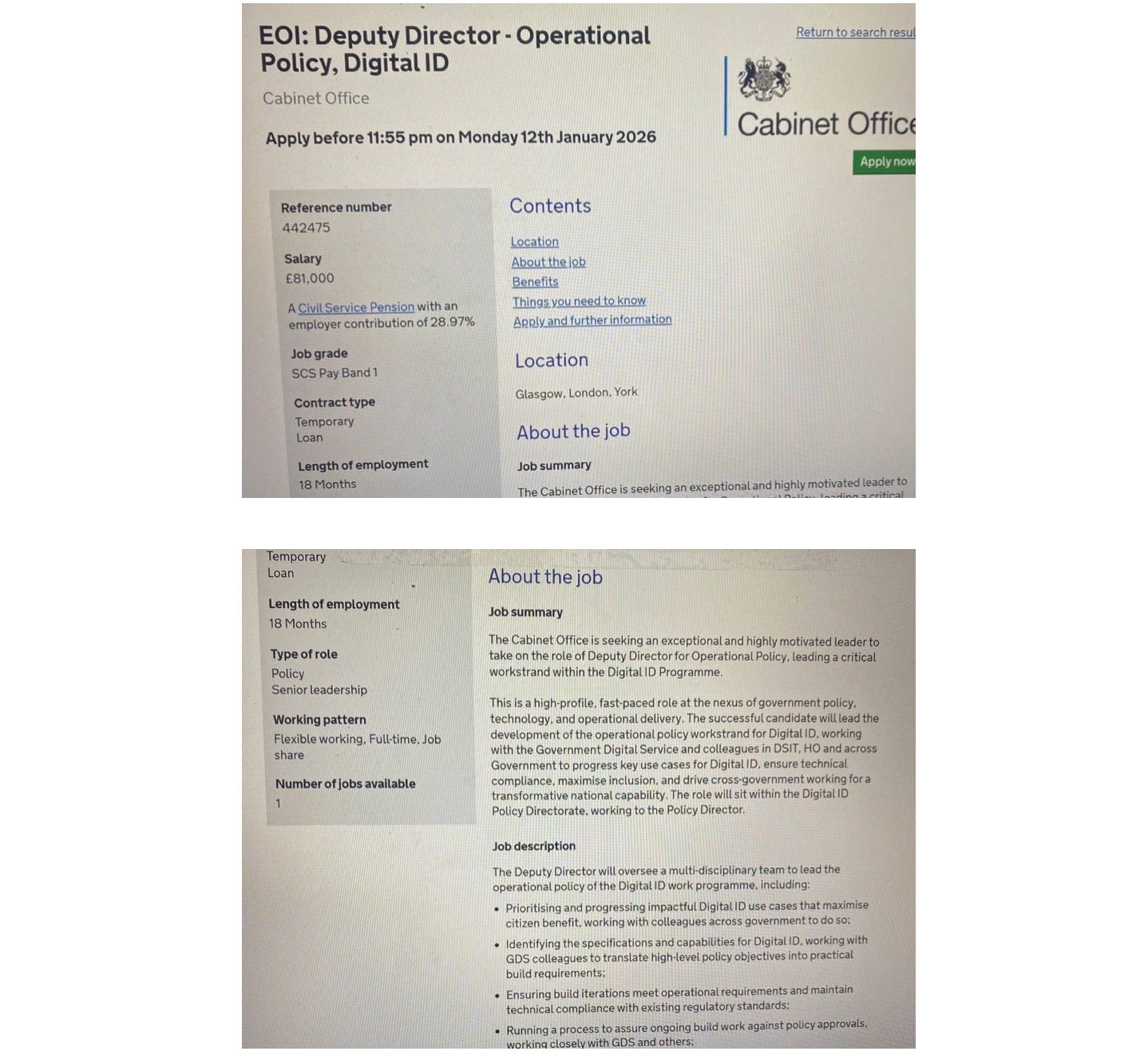
“The Digital ID Programme… at the nexus of government policy, technology and operational delivery… the Digital ID Policy Directorate…”
I am inclined to take headlines about government U-turns on digital ID with more than a pinch of salt.
Finally, and further to this section of November’s Updates post…
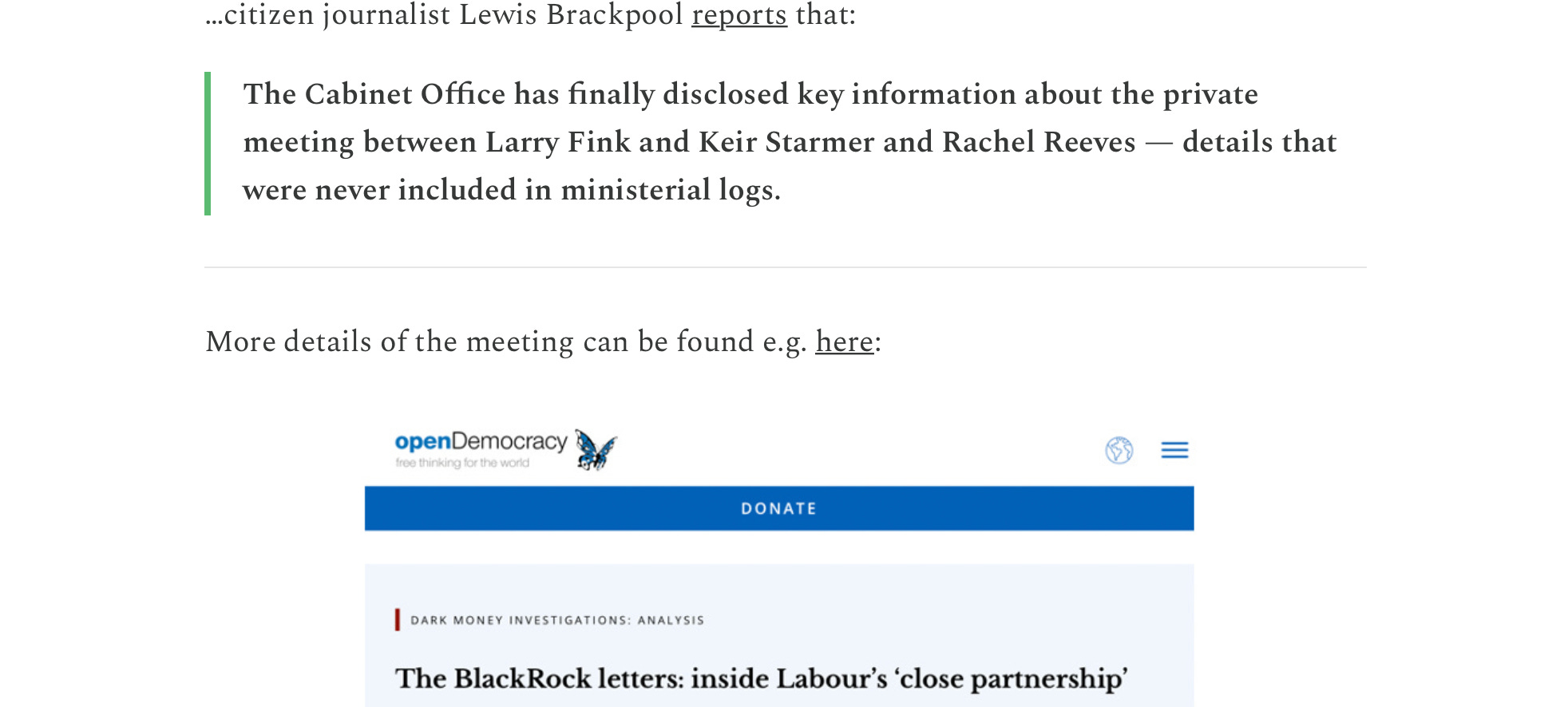
Brackpool also reports that:
For the third time, the Cabinet Office has delayed responding to a Freedom of Information request submitted in October 2025 concerning government meetings involving Oracle and senior ministers.
Oracle is one of the world’s largest technology corporations, specialising in government data infrastructure, cloud services, surveillance-adjacent analytics, and artificial intelligence systems used by states across the world.
Its founder, Larry Ellison, has publicly spoken about how modern digital systems, particularly AI-driven platforms, can be used by governments to shape, influence, and regulate human behaviour at scale.
These remarks are on the public record and have been widely reported.
We should hope to receive a response by the 6th of February.
Related:


Unexpected Turns homepage
The most-read articles can be found here
And of course these days it is important to ask whether video footage is actually real