
Hidden history (part 1)
Cecil Rhodes and his extraordinary "Confession of Faith"

This is the first of several posts in advance of Armistice Day. And, with a view to providing some important context for a forthcoming article, it features one of the most influential figures of the late 19th and early 20th centuries:
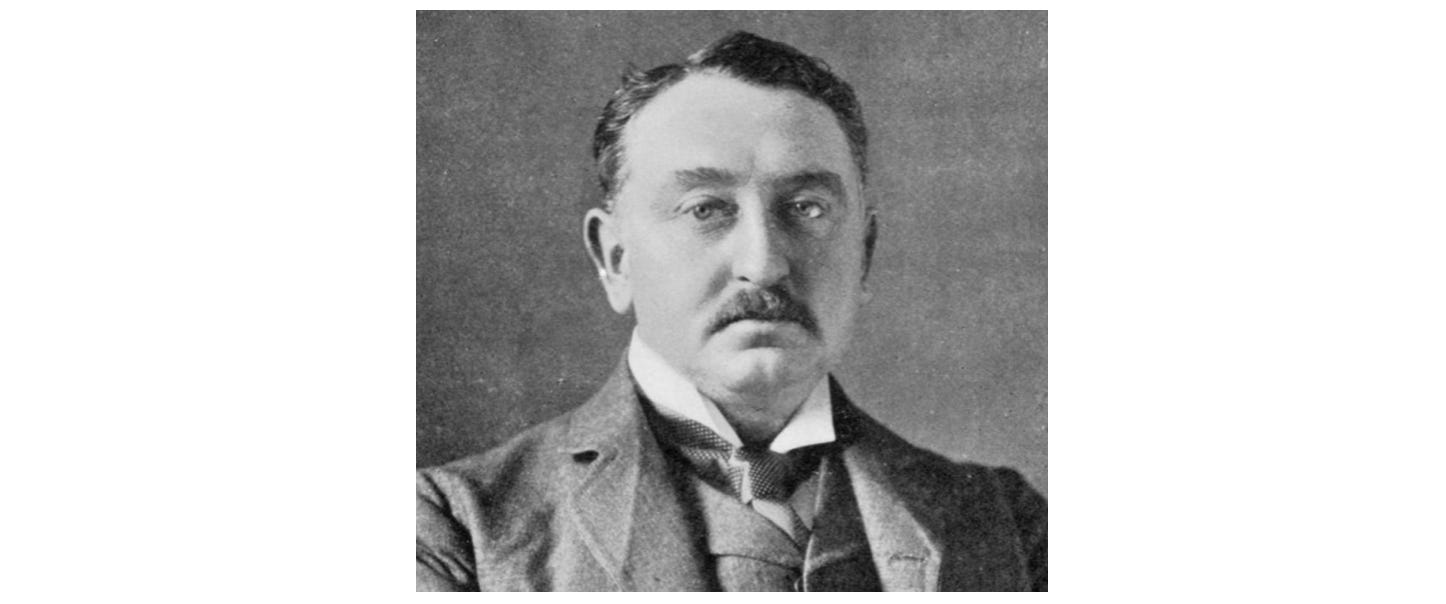
As I recall, I first encountered Cecil Rhodes’ name in the context of the Rhodes Scholarship scheme, which is, in the words of its website, “a fully-funded postgraduate award which enables talented young people from around the world to study full-time at the University of Oxford”.
More recently, it was hard to miss the 2021 controversy over the statue of Rhodes that stands on the Oriel College building named after him:

I am struck by the way in which the extraordinary events of 2021 now feel like a long time ago. And I wonder how well, even a mere four years later, we can put those events into context.
But if it is a challenge to put events from a few years ago into context, how about trying to get ourselves into the mindset of people living around 150 years earlier!?
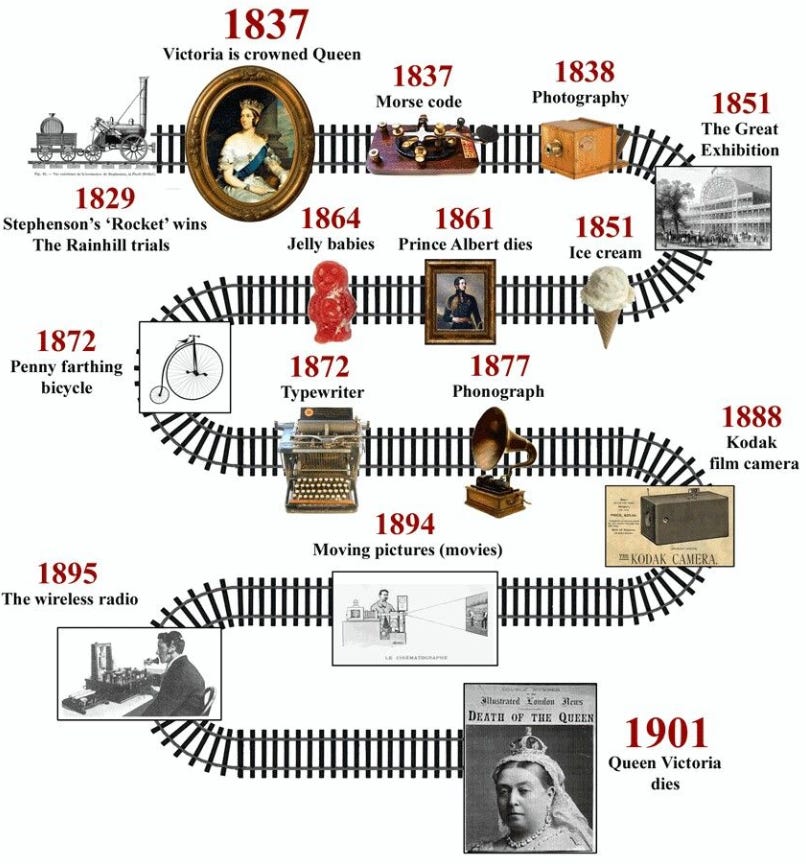
The second half of the nineteenth century saw an impressive array of inventions — from reinforced concrete (1853) and dynamite (1867), to the telephone (1876) and the incandescent light bulb (1879), to the first petrol-powered car (1886) and the diesel engine (1893). And the same period also saw the invention of pasteurization (1864), the ballpoint pen1 (1888), the rubber glove (1893) and the radio (1895). I guess it must have seemed like a time of extraordinary progress.
The Rhodes Trust acknowledges that Rhodes — who was born in 1853, but died in 1902 at the age of 48 — was:
…a figure who divided opinion even in his own lifetime.
It gives two examples that illustrate the point:
The Indian-born imperialist writer Rudyard Kipling thought him ‘the greatest of living men’, while to South African progressive author Oliver Schreiner he came to mean ‘so much of oppression, injustice, and moral degradation to South Africa’.
And states that:
Rhodes himself was committed to imperialist ideas which (unlike many critics at the time and subsequently) he saw as the key to political and economic progress. He was once heard to say that ‘It is the dreamers who move the world’ and there is no doubt that his ideas and actions were massively influential. You can read more about the debates surrounding his life and legacy here.
It also provides this further context (emphasis added):
Born in England, Rhodes travelled to southern Africa at the age of 17, and it was the wealth he drew from the people and resources of that region — principally through mining diamonds and gold — that made him both immensely rich and extremely powerful. He was ruthless in his pursuit of concessions that would allow him to extend his mining activities. Perhaps most famously, his agents deliberately deceived King Lobengula of the Ndebele Kingdom regarding the extent of control they were proposing over the lands of the Ndebele people. The British South Africa Company (BSAC), founded by Rhodes, colonised the inland regions of southern Africa between the Limpopo River and Lake Tanganyika. In 1880, BSAC renamed the area north of the Zambezi River Northern Rhodesia (this would become Zambia in 1964) while the area to the south was initially named Southern Rhodesia (becoming Zimbabwe in 1980). Rhodes went on to become prime minister of Cape Colony.
From relatively early on in his life, Rhodes had been thinking about ways to ‘extend the influence of the English-speaking race’. When he died, he left around £3.7 million (equivalent to over £650 million today) for the foundation of scholarships to bring young men from the British colonies (and the United States and Germany) to study in Oxford ‘for instilling into their minds the advantage to the Colonies as well as to the United Kingdom of the retention of the unity of the Empire’. These became the Rhodes Scholarships, the first international postgraduate scholarship programme.
And the first sentence of that last paragraph in turn provides context for Cecil Rhodes’ extraordinary “Confession of Faith” made in 1877.

The text is below, unedited bar my added emphasis:2
It often strikes a man to inquire what is the chief good in life; to one the thought comes that it is a happy marriage, to another great wealth, and as each seizes on his idea, for that he more or less works for the rest of his existence. To myself thinking over the same question the wish came to render myself useful to my country.
I then asked myself how could I and after reviewing the various methods I have felt that at the present day we are actually limiting our children and perhaps bringing into the world half the human beings we might owing to the lack of country for them to inhabit that if we had retained America there would at this moment be millions more of English living.
I contend that we are the finest race in the world and that the more of the world we inhabit the better it is for the human race. Just fancy those parts that are at present inhabited by the most despicable specimens of human beings what an alteration there would be if they were brought under Anglo-Saxon influence, look again at the extra employment a new country added to our dominions gives.
I contend that every acre added to our territory means in the future birth to some more of the English race who otherwise would not be brought into existence. Added to this the absorption of the greater portion of the world under our rule simply means the end of all wars, at this moment had we not lost America I believe we could have stopped the Russian-Turkish war by merely refusing money and supplies. Having these ideas what scheme could we think of to forward this object. I look into history and I read the story of the Jesuits I see what they were able to do in a bad cause and I might say under bad leaders.
At the present day I become a member of the Masonic order I see the wealth and power they possess the influence they hold and I think over their ceremonies and I wonder that a large body of men can devote themselves to what at times appear the most ridiculous and absurd rites without an object and without an end.
The idea gleaming and dancing before ones eyes like a will-of-the-wisp at last frames itself into a plan. Why should we not form a secret society with but one object the furtherance of the British Empire and the bringing of the whole uncivilised world under British rule for the recovery of the United States for the making the Anglo-Saxon race but one Empire. What a dream, but yet it is probable, it is possible.I once heard it argued by a fellow in my own college, I am sorry to own it by an Englishman, that it was good thing for us that we have lost the United States. There are some subjects on which there can be no arguments, and to an Englishman this is one of them, but even from an American’s point of view just picture what they have lost, look at their government, are not the frauds that yearly come before the public view a disgrace to any country and especially their’s which is the finest in the world.
Would they have occurred had they remained under English rule great as they have become how infinitely greater they would have been with the softening and elevating influences of English rule, think of those countless 000’s of Englishmen that during the last 100 years would have crossed the Atlantic and settled and populated the United States. Would they have not made without any prejudice a finer country of it than the low class Irish and German emigrants?
All this we have lost and that country loses owing to whom? Owing to two or three ignorant pig-headed statesmen of the last century, at their door lies the blame. Do you ever feel mad? do you ever feel murderous. I think I do with those men. I bring facts to prove my assertion. Does an English father when his sons wish to emigrate ever think of suggesting emigration to a country under another flag, never — it would seem a disgrace to suggest such a thing I think that we all think that poverty is better under our own flag than wealth under a foreign one.
Put your mind into another train of thought. Fancy Australia discovered and colonised under the French flag, what would it mean merely several millions of English unborn that at present exist we learn from the past and to form our future. We learn from having lost to cling to what we possess. We know the size of the world we know the total extent. Africa is still lying ready for us it is our duty to take it. It is our duty to seize every opportunity of acquiring more territory and we should keep this one idea steadily before our eyes that more territory simply means more of the Anglo-Saxon race more of the best the most human, most honourable race the world possesses.
To forward such a scheme what a splendid help a secret society would be a society not openly acknowledged but who would work in secret for such an object.
I contend that there are at the present moment numbers of the ablest men in the world who would devote their whole lives to it. I often think what a loss to the English nation in some respects the abolition of the Rotten Borough System has been. What thought strikes a man entering the house of commons, the assembly that rule the whole world? I think it is the mediocrity of the men but what is the cause. It is simply — an assembly of wealth of men whose lives have been spent in the accumulation of money and whose time has been too much engaged to be able to spare any for the study of past history. And yet in hands of such men rest our destinies. Do men like the great Pitt, and Burke and Sheridan not now to exist. I contend they do. There are men now living with I know no other term the [Greek term] of Aristotle but there are not ways for enabling them to serve their Country. They live and die unused unemployed. What has the main cause of the success of the Romish Church? The fact that every enthusiast, call it if you like every madman finds employment in it. Let us form the same kind of society a Church for the extension of the British Empire. A society which should have members in every part of the British Empire working with one object and one idea we should have its members placed at our universities and our schools and should watch the English youth passing through their hands just one perhaps in every thousand would have the mind and feelings for such an object, he should be tried in every way, he should be tested whether he is endurant, possessed of eloquence, disregardful of the petty details of life, and if found to be such, then elected and bound by oath to serve for the rest of his life in his County. He should then be supported if without means by the Society and sent to that part of the Empire where it was felt he was needed.
Take another case, let us fancy a man who finds himself his own master with ample means of attaining his majority whether he puts the question directly to himself or not, still like the old story of virtue and vice in the Memorabilia a fight goes on in him as to what he should do. Take if he plunges into dissipation there is nothing too reckless he does not attempt but after a time his life palls on him, he mentally says this is not good enough, he changes his life, he reforms, he travels, he thinks now I have found the chief good in life, the novelty wears off, and he tires, to change again, he goes into the far interior after the wild game he thinks at last I’ve found that in life of which I cannot tire, again he is disappointed. He returns he thinks is there nothing I can do in life? Here I am with means, with a good house, with everything that is to be envied and yet I am not happy I am tired of life he possesses within him a portion of the [Greek term] of Aristotle but he knows it not, to such a man the Society should go, should test, and should finally show him the greatness of the scheme and list him as a member.
Take one more case of the younger son with high thoughts, high aspirations, endowed by nature with all the faculties to make a great man, and with the sole wish in life to serve his Country but he lacks two things the means and the opportunity, ever troubled by a sort of inward deity urging him on to high and noble deeds, he is compelled to pass his time in some occupation which furnishes him with mere existence, he lives unhappily and dies miserably. Such men as these the Society should search out and use for the furtherance of their object.
(In every Colonial legislature the Society should attempt to have its members prepared at all times to vote or speak and advocate the closer union of England and the colonies, to crush all disloyalty and every movement for the severance of our Empire. The Society should inspire and even own portions of the press for the press rules the mind of the people. The Society should always be searching for members who might by their position in the world by their energies or character forward the object but the ballot and test for admittance should be severe)
Once make it common and it fails. Take a man of great wealth who is bereft of his children perhaps having his mind soured by some bitter disappointment who shuts himself up separate from his neighbours and makes up his mind to a miserable existence. To such men as these the society should go gradually disclose the greatness of their scheme and entreat him to throw in his life and property with them for this object. I think that there are thousands now existing who would eagerly grasp at the opportunity. Such are the heads of my scheme.
For fear that death might cut me off before the time for attempting its development I leave all my worldly goods in trust to S. G. Shippard and the Secretary for the Colonies at the time of my death to try to form such a Society with such an object.
In the same year, Rhodes drafted his first will. And the first clause of that will bequeathed his wealth as follows:3

To and for the establishment, promotion and development of a Secret Society, the true aim and object whereof shall be for the extension of British rule throughout the world, the perfecting of a system of emigration from the United Kingdom, and of colonisation by British subjects of all lands where the means of livelihood are attainable by energy, labour and enterprise, and especially the occupation by British settlers of the entire Continent of Africa, the Holy Land, the Valley of the Euphrates, the Islands of Cyprus and Candia [now Crete], the whole of South America, the Islands of the Pacific not heretofore possessed by Great Britain, the whole of the Malay Archipelago, the seaboard of China and Japan, the ultimate recovery of the United States of America as an integral part of the British Empire, the inauguration of a system of Colonial representation in the Imperial Parliament which may tend to weld together the disjointed members of the Empire and, finally, the foundation of so great a Power as to render wars impossible and promote the best interests of humanity.
The relevance of the above to Armistice Day in 2025 will become clearer in a subsequent post.
Update — that subsequent post:

Related:

![The invisible governors [2025 re-issue]](https://substackcdn.com/image/fetch/$s_!9xQ7!,w_140,h_140,c_fill,f_webp,q_auto:good,fl_progressive:steep,g_auto/https%3A%2F%2Fsubstack-post-media.s3.amazonaws.com%2Fpublic%2Fimages%2Fbcaa3173-3008-42b5-969e-1959f54453f7_1160x1138.png)
Unexpected Turns homepage
The most-read articles can be found here
The biro came much later, c/o László Bíró in the 1930s
Which is different from that at the link and in the snapshot
At the bottom of the previous link to Rhodes’ “Confession of Faith”