
Hidden history (part 2)
To what extent have we been told the truth about World War I?

This is the second of several posts in advance of Armistice Day. It follows this article featuring Cecil Rhodes…

…who, in the words of the Rhodes Trust website:
…travelled to southern Africa at the age of 17, and it was the wealth he drew from the people and resources of that region — principally through mining diamonds and gold — that made him both immensely rich and extremely powerful. He was ruthless in his pursuit of concessions that would allow him to extend his mining activities…
The same website also says that:
From relatively early on in his life, Rhodes had been thinking about ways to ‘extend the influence of the English-speaking race’. When he died, he left around £3.7 million (equivalent to over £650 million today) for the foundation of scholarships to bring young men from the British colonies (and the United States and Germany) to study in Oxford ‘for instilling into their minds the advantage to the Colonies as well as to the United Kingdom of the retention of the unity of the Empire’…
In Rhodes’ extraordinary 1877 Confession of Faith, he stated, among other things, that:
I contend that we [English] are the finest race in the world and that the more of the world we inhabit the better it is for the human race…
At the present day I become a member of the Masonic order I see the wealth and power they possess the influence they hold…
The idea gleaming and dancing before ones eyes like a will-of-the-wisp at last frames itself into a plan. Why should we not form a secret society with but one object the furtherance of the British Empire and the bringing of the whole uncivilised world under British rule for the recovery of the United States for the making the Anglo-Saxon race but one Empire. What a dream, but yet it is probable, it is possible…
We learn from having lost to cling to what we possess. We know the size of the world we know the total extent. Africa is still lying ready for us it is our duty to take it. It is our duty to seize every opportunity of acquiring more territory and we should keep this one idea steadily before our eyes that more territory simply means more of the Anglo-Saxon race more of the best the most human, most honourable race the world possesses.
To forward such a scheme what a splendid help a secret society would be a society not openly acknowledged but who would work in secret for such an object…Let us form… a society which should have members in every part of the British Empire working with one object and one idea…
The Society should inspire and even own portions of the press for the press rules the mind of the people. The Society should always be searching for members who might by their position in the world by their energies or character forward the object but the ballot and test for admittance should be severe)…
For fear that death might cut me off before the time for attempting its development I leave all my worldly goods in trust… at the time of my death to try to form such a Society with such an object.
And his first will, drafted the same year, apparently began as follows:1
To and for the establishment, promotion and development of a Secret Society, the true aim and object whereof shall be for the extension of British rule throughout the world…
Hidden history
Those words of the “immensely rich and extremely powerful” Rhodes’ provide important context for books such as Hidden History: The Secret Origins of the First World War:

Until fairly recently, I had taken at face value the mainstream narrative on World War I, which I first encountered in GCSE history lessons: essentially that the Great War was a tragic conflict sparked by the assassination of Archduke Franz Ferdinand which resulted in warfare on an unprecedented scale, with the Allies eventually triumphing over the Central Powers. While history was far from my favourite subject, I found the WWI part of the syllabus engaging enough. And I can still remember sitting in the classroom listening to Mr Holt methodically laying out what happened and when.
I cannot remember when I first encountered the notion that “history is written by the victors”. But my working assumption — and, as far as I could tell, that of everybody else I knew — was that even though the Brits were victorious in WWI we had broadly been told the truth about what happened. And the conventional line was reinforced in my mind by the annual Remembrance Day parades and church services that I attended as a child.
At school, WWI also featured in the GCSE English Literature syllabus. I remember studying Wilfred Owen’s Dulce et Decorum Est — literally “It is sweet and proper [to die for one’s country]” — alongside other poems such as Warty Bliggens, the Toad. But while Owen wrote eloquently in condemnation of war, I don’t recall the fundamentals of the historical narrative ever being called into serious question. And I would also say something similar of Blackadder IV, which I found — and still find — to be among the cleverest and funniest comedy programmes around. This short clip conveys something of its flavour:
But in recent years I have learned, slowly but surely, that we should be wary of taking at face value what our authorities tell us, and that it is wise to consider carefully what we are being told and why.
And so when I saw someone recommending Hidden History, I thought I’d take a look.
A summary
In terms of an overview, it is hard to do better than this summary by The Naked Emperor:2
A new theory on how World War I started — not with the assassination of Archduke Franz Ferdinand, but rather 10 years earlier, by power-hungry men whose lies have infiltrated history
Hidden History uniquely exposes those responsible for World War I. It reveals how accounts of the war’s origins have been deliberately falsified to conceal the guilt of the secret cabal of very rich and powerful men in London responsible for the most heinous crime perpetrated on humanity.
For 10 years, they plotted the destruction of Germany as the first stage of their plan to take control of the world. The assassination of Archduke Franz Ferdinand was no chance happening. It lit a fuse that had been carefully set through a chain of command stretching from Sarajevo through Belgrade and St. Petersburg to that cabal in London.
Our understanding of these events has been firmly trapped in a web of falsehood and duplicity carefully constructed by the victors at Versailles in 1919 and maintained by compliant historians ever since. The official version is fatally flawed, warped by the volume of evidence they destroyed or concealed from public view.
Hidden History poses a tantalizing challenge. The authors ask only that you examine the evidence they lay before you.
A web of falsehood and duplicity carefully constructed by the victors at Versailles in 1919 and maintained by compliant historians ever since…
While the part about a “secret cabal3 of very rich and powerful men in London” who “plotted the destruction of Germany as the first stage of their plan to take control of the world” might sound far-fetched, it certainly fits with Cecil Rhodes’ Confession of Faith. And the claims of Hidden History are not unfounded. The Naked Emperor’s final sentence is surely particularly important:
The authors ask only that you examine the evidence they lay before you.
And I would say something very similar of this Substack.
But I wonder, not least in the context of the past five years, to what extent people are actually open to examining such evidence.
Prof Carroll Quigley
Hidden History is accessible, well-written and thoroughly referenced. The authors draw extensively on the work of US professor Carroll Quigley, who obtained a BA (“magna cum laude”), MA and PhD from Harvard, and subsequently taught at Princeton, at Harvard and, from 1941 to 1976, at the School of Foreign Service at Georgetown University:

A series of Quigley’s audio recordings can be found e.g. here on YouTube. And further information can be found on the Georgetown University Archival Resources website:
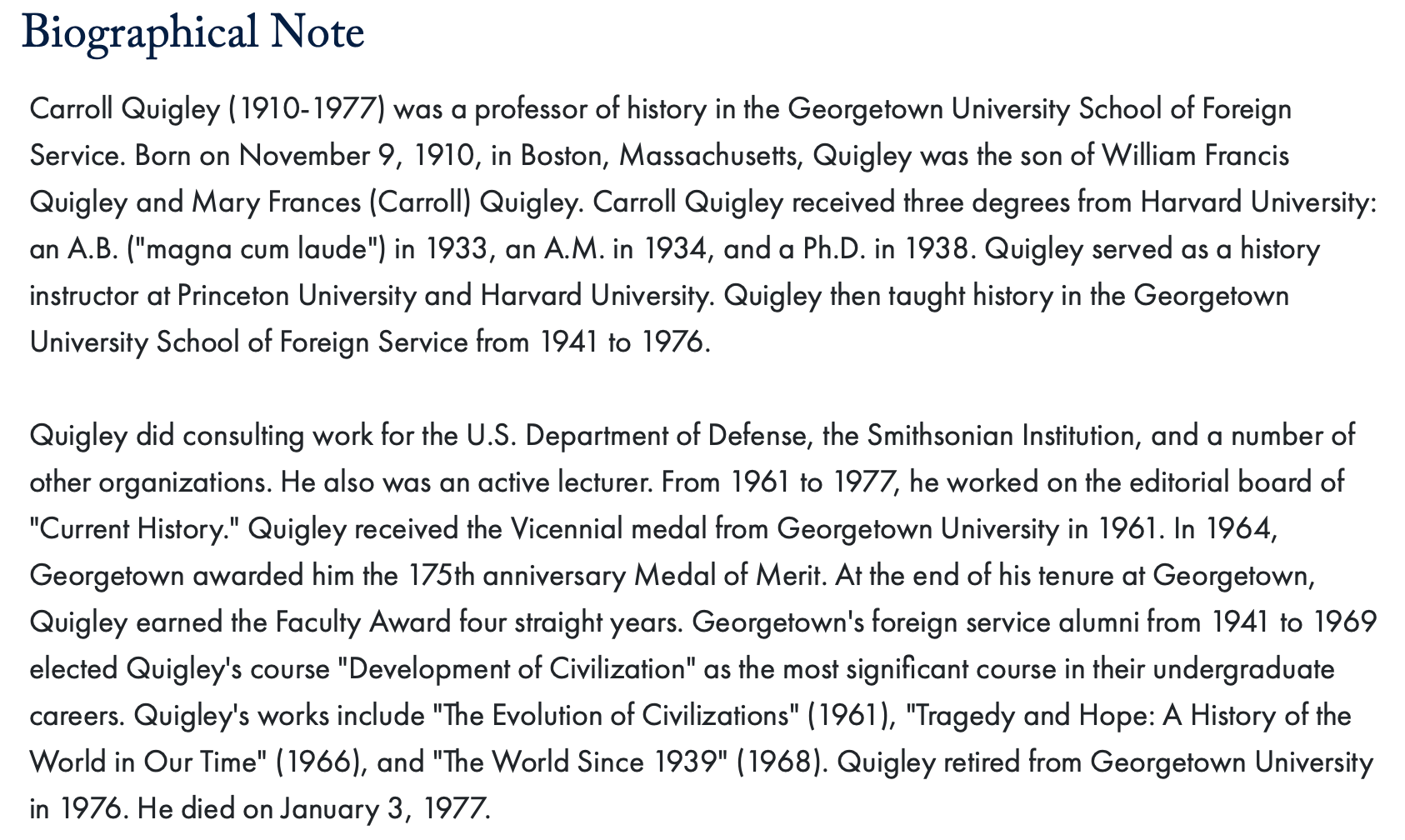
Quigley did consulting work for the U.S. Department of Defense, the Smithsonian Institution, and a number of other organizations. He also was an active lecturer. From 1961 to 1977, he worked on the editorial board of “Current History.” Quigley received the Vicennial medal from Georgetown University in 1961. In 1964, Georgetown awarded him the 175th anniversary Medal of Merit. At the end of his tenure at Georgetown, Quigley earned the Faculty Award four straight years. Georgetown’s foreign service alumni from 1941 to 1969 elected Quigley’s course “Development of Civilization” as the most significant course in their undergraduate careers.
At the very least, he sounds like someone worth paying some attention to.
Why had I never heard this perspective before?
Reading Hidden History left me with plenty of questions, not so much about the details but the bigger picture. And not least: Why had I never heard this perspective before?
Part of the reason is that I had not taken the trouble to look. Until recently, there were plenty of other things in which I was rather more interested than history. And I had simply accepted at face value the narrative that I had been taught at school, which had in turn been reinforced by various books, films and television programmes.
But in any case, it is not so easy to find other perspectives in the mainstream media. For example, when I used Google to search for Carroll Quigley on the bbc.co.uk, guardian.co.uk and telegraph.co.uk websites, I did not readily find anything of interest.4 And while the evidence presented by the likes of Quigley and the authors of Hidden History is available — for now at least — to those who are looking for it, anyone getting most of their information from the mainstream media might never even know that it existed. I cannot help but recall Cecil Rhodes’ 1877 aspiration that the Society of which he dreamt “should inspire and even own portions of the press for the press rules the mind of the people”.
More broadly, I wonder how much of the relevant evidence has even reached the public domain. According to this 2013 article from The Guardian, the UK’s Foreign Office “has unlawfully hoarded more than a million files of historic documents that should have been declassified and handed over to the National Archives”:

The Foreign Office has unlawfully hoarded more than a million files of historic documents that should have been declassified and handed over to the National Archives, the Guardian has discovered.
The files are being kept at a secret archive at a high-security government communications centre in Buckinghamshire, north of London, where they occupy mile after mile of shelving.
Most of the papers are many decades old — some were created in the 19th century — and document in fine detail British foreign relations throughout two world wars, the cold war, withdrawal from empire and entry into the common market.
They have been kept from public view in breach of the Public Records Acts, which requires that all government documents become public once they are 30 years old — a term about to be reduced to 20 years – unless the department has received permission from the lord chancellor to hold them for longer. The secret archive is also beyond the reach of the Freedom of Information Act.
The Foreign Office is not the only government department that has been unlawfully hoarding files. This month the Guardian disclosed that the Ministry of Defence was unlawfully holding more than 66,000 historic files at a warehouse in Derbyshire, including thousands of files from the army’s Northern Ireland headquarters.
However, the Foreign Office’s secret archive, which is estimated to hold around 1.2 [million] files and occupies around 15 miles of floor-to-ceiling shelving, is believed to be far larger than the combined undisclosed archives of every other government department. One of Britain’s leading historians describes its size as “staggering”.
15 miles of floor-to-ceiling shelving…
I am reminded of The Naked Emperor’s contention that the official version of [the history of WWII] is fatally flawed, warped by the volume of evidence they destroyed or concealed from public view.
Patterns in repeat
On reading Hidden History, I was repeatedly struck by the similarities between how things operated a hundred or so years ago and how they operate today. And in particular by the role of the press in “[ruling] the mind of the people” — to use Rhodes’ phrase. Technology has doubtless progressed enormously, but I suspect that the perspective of our invisible governors has not changed much.
Something else that seems not to have changed much is the manipulation — one way or another — of MPs and government ministers by wealthy and influential figures. In terms of war, I am reminded of the allegation that in 2022 Boris Johnson ordered Ukraine’s President Zelensky to continue the war despite Russia reportedly being ready to end the war and withdraw its troops in exchange for Ukrainian neutrality. Johnson has rubbished such claims, but he doesn’t exactly have an unblemished record of telling the truth, not least in relation to his claim of having “nearly died” from covid.
More broadly, I cannot help but think of the Trusted News Initiative established in 2019…

…founded by the BBC, and including organisations from around the globe, among them Google/YouTube, Meta (Facebook etc.), Microsoft, Thomson Reuters and Twitter (now X)….
…and certain recent prominent stories in the media:

And in relation to the covid era, I can certainly see plenty of parallels between the UK government’s hoarding of historic documents and more recent obfuscation, not least that featured in these posts:


The UK’s Office for National Statistics modelling away the excess mortality data also springs to mind.
A taster
One of the most distinctive things about Hidden History is that the authors — Gerry Docherty (a former head teacher)5 and Jim MacGregor (a former GP) — helpfully provide a list of summary points for each of the book’s 27 chapters. By way of illustration, and as something of a taster, here is the summary for chapter 1, titled The Secret Society:
In 1891, a secret society comprising members of the English ruling class was formed in London with the long-term goal of taking control of the world.
This organisation would have remained unknown had it not been for the research of the eminent American scholar Professor Carroll Quigley. He was given access to information that revealed the conspiracy and its impact on major events in the twentieth century.
Funded and founded by Cecil Rhodes, a select group of men were chosen for the inner circle or ‘elect’ that would secretly control British colonial and foreign policy. Other associates were drawn in from time to time, and may or may not have known what they were involved in.
Two essential components of their shared approach were secrecy and an understanding that the reality of power was much more important than the appearance of power.
They built on the longstanding power and patronage that the Salisbury and Rosebery families exercised in British politics, but also included the Rothschild dynasty of international financiers who were very close to the British Establishment.
In the early years, the leading activists were Cecil Rhodes, William Stead, Lord Esher, Alfred Milner and Lord Nathaniel Rothschild.
Renewal and strengthening of the bond between Britain and the United States of America was a central plank of Secret Elite policy.
By the mid-nineteenth century, the House of Rothschild, based in London, Paris, Frankfurt and Vienna, dominated European finance.
Their holdings branched out across the world into new investments in steel, railways and oil; Cecil Rhodes’ diamond and gold companies were bankrolled by the Rothschilds.
The Rothschilds preferred to operate behind other companies so that few realised exactly what and how much they controlled.
They targeted and financed relatively indebted royalty, including members of the British royal family. They purchased the Suez Canal shares for Disraeli and gave generously to politicians whom they supported. In Britain, their generosity and patronage broke down many of the anti-Semitic barriers they had to endure.
Nathaniel Rothschild was intimately associated with Cecil Rhodes and his secret society from the outset. The powerful alliance of the ‘money men’, the ‘men behind the curtain’ and the emergence of Alfred Milner as leader gave the Secret Elite a cutting edge to make Rhodes’ dream a reality.
I think Hidden History would make a fine Christmas present for anyone with an interest in history and an open mind.
Prolonging the Agony
But there is more. Five years after Hidden History, the authors MacGregor and Docherty published Prolonging the Agony: How the Anglo-American Establishment Deliberately Extended WWI by Three-And-A-Half Years:

The format is similar to Hidden History. And the subtitle and blurb provide an accurate summary of the book’s thesis:
The fact that governments lie is generally accepted today, but World War I was the first global conflict in which millions of young men were sacrificed for hidden causes. They did not die to save civilization; they were killed for profit and in the hopes of establishing a one-world government. By 1917, America had been thrust into the war by a President who promised to stay out of the conflict. But the real power behind the war consisted of the bankers, the financiers, and the politicians, referred to, in this book, as The Secret Elite. Scouring government papers on both sides of the Atlantic, memoirs that avoided the censor’s pen, speeches made in Congress and Parliament, major newspapers of the time, and other sources, Prolonging the Agony maintains that the war was deliberately and unnecessarily prolonged and that the gross lies ingrained in modern “histories” still circulate because governments refuse citizens the truth. Featured in this book are shocking accounts of the alleged Belgian “outrages,” the sinking of the Lusitania, the manipulation of votes for Herbert Hoover, Lord Kitchener’s death, and American and British zionists in cahoots with Rothschild’s manipulated Balfour Declaration. The proof is here in a fully documented exposé — a real history of the world at war.
It is surely not necessary to be an Only Connect type of person to see parallels with the events of recent years…
Millions sacrificed for hidden causes… killed for profit… the real power consisting of the bankers, the financiers and compromised and/or corruptible politicians…
Censorship… in the context of a manufactured crisis situation deliberately and unnecessarily prolonged… gross lies ingrained… governments refusing citizens the truth…
And… not mentioned in the blurb, but featured in the book: UK church leaders promoting pertinent propaganda… which will be the subject of a forthcoming post.
Update: here is that post:

AIII118
And finally, on the subject of WWI, and the assassination of Archduke Franz Ferdinand in particular, I recently discovered that the car in which he was travelling when he was shot had the registration plate AIII118…
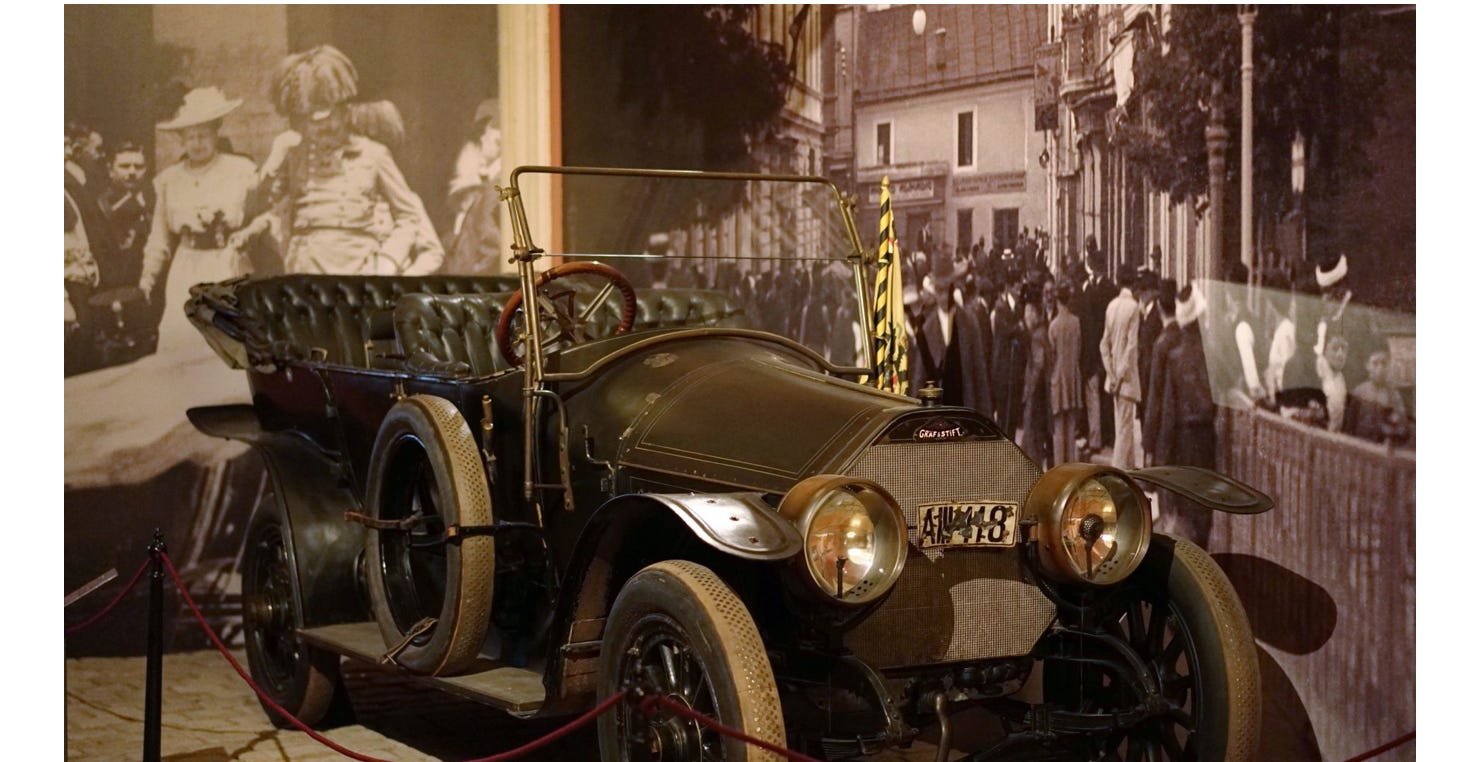
…which of course bears more than a passing resemblance to the date of 11th November 1918 — or 11/11/18 — on which the World War I Armistice was signed.
Here is a Sky News piece from Sunday 11th November 2018, exactly a hundred years on:
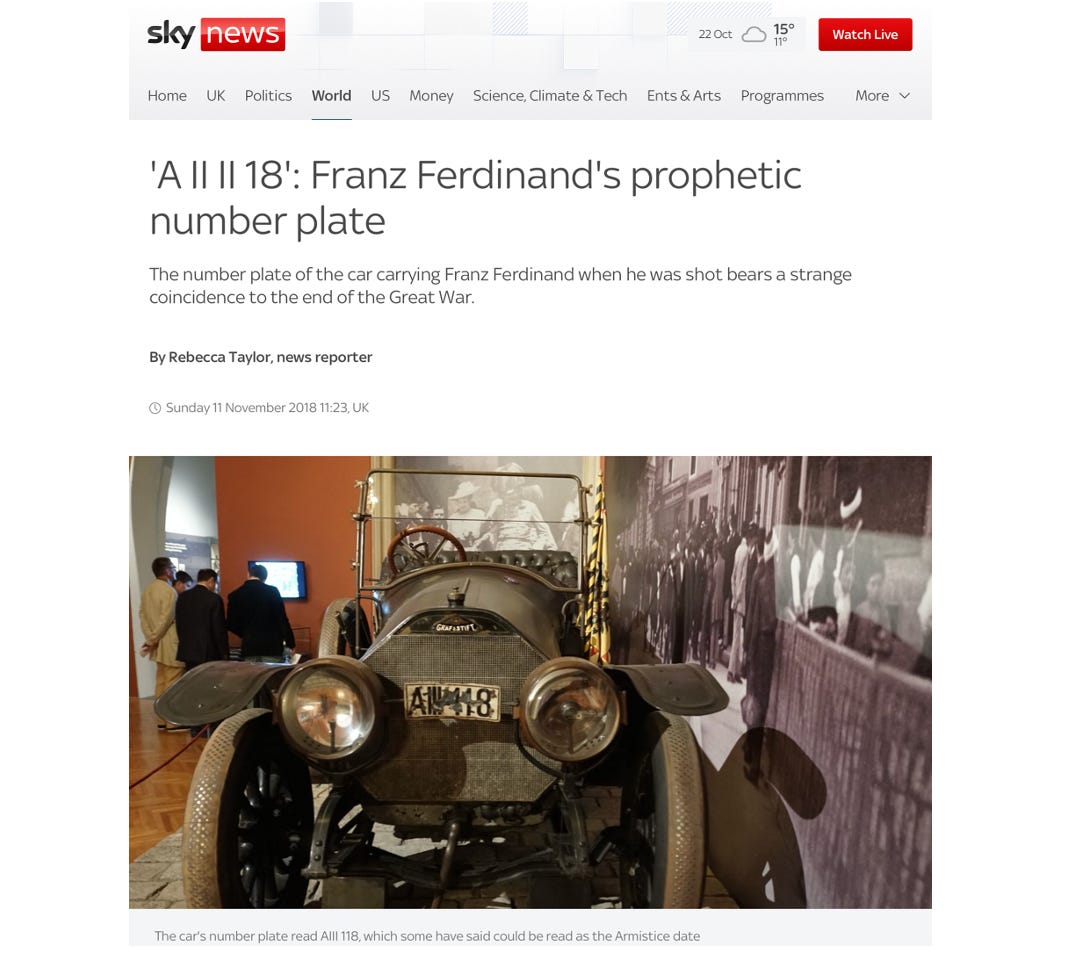
The article states that:
Sky’s royal commentator Alistair Bruce tweeted: “Thinking of irony that car in which Archduke Frank Ferdinand was shot in #Sarajevo (catalyst to #1WW) bore number plate ‘A111118’ - Armistice 11 11 18 #spooky.”
Related:


![Minority reports [2025 re-issue]](https://substackcdn.com/image/fetch/$s_!3rbi!,w_140,h_140,c_fill,f_webp,q_auto:good,fl_progressive:steep,g_auto/https%3A%2F%2Fsubstack-post-media.s3.amazonaws.com%2Fpublic%2Fimages%2F61317059-4827-421a-9109-6b3603d7d092_1096x998.png)


Unexpected Turns homepage
The most-read articles can be found here
At the bottom of the previous link to Rhodes’ “Confession of Faith”
Although as noted later, with reference to US professor Carroll Quigley, the theory is not actually new
Apparently derived from kabbalah, but also a group of ministers of Charles II that governed from 1667–73 with the initials C, A, B, A and L (Clifford, Ashley, Buckingham, Arlington, and Lauderdale)
There was a hit from the Guardian website, but it appeared to contain no reference to the US professor of history