
Understanding Trauma
A book review of sorts; and "Societal PTSD"

I read the recently published book Understanding Trauma with interest:

One reason is that I had the privilege of hearing the author — Dr Steve Midgley — speak some years ago. He had worked as worked as a psychiatrist in the NHS before becoming a pastor. He is now the Executive Director of Biblical Counselling UK.
But another reason for reading Understanding Trauma is the context of what I have come to view as something resembling a form of collective trauma that was visited upon the world’s population at large during the covid era under the guise of “a public health emergency”.
The deployment of behavioural psychology…

…has been so successful that few people have begun to recognise the psychological abuse…

…to which we were subjected in the name of “safety” and the “welfare of the people” which has always been the alibi of tyrants:

I was particularly struck by how closely the events of the covid era resembled the textbook psychology that is Biderman’s Chart of Coercion:

The use of the word “trauma” in the context of the covid era
At the outset, I should make it clear that I found Understanding Trauma well worth the time, and would recommend it, even for those with no interest in the church angle.
But before discussing the book’s contents in more detail, I thought it worth noting that, although the book was published this year, there is only a passing mention of the covid era, in the context of the use of the word “trauma” (p31):
Because the word “trauma” is used in [lots of] different ways, misunderstandings are inevitable. When someone talks about trauma, they may be doing so in a colloquial and casual way or with a formal medical diagnosis in mind. It’s somewhat similar to our use of the word “depression”, which can also be used in a very wide range of different ways.
The Covid pandemic only increased references to trauma. Lockdown experiences were identified as a society-wide trauma that affected all of us. It was an opinion piece about our experience of lockdown that spoke of “how trauma became the word of the decade”.
The problem with the language of trauma becoming more and more widely used is that it begins to lose its meaning altogether. If everything negative is trauma, then in one sense it becomes a meaningless term. The focus of this book will be on “big T” trauma — on the rare and more exceptional events (whether one-off or repeated) that result in people experiencing ongoing struggles in daily life.
I think the general point about language is a fair one.
But I am reminded of what I suspect many people — even some psychiatric professionals — would view as genuinely traumatic experiences of the covid era, at least some of which I think could be considered as contenders for “big T” trauma status.
Examples of experiences of the covid era that could be considered as contenders for “big T” trauma status
The experience of children as described in e.g. the “Abuse and neglect” section of this post…
Some incidences of “abusive head trauma during the COVID-19 pandemic” were eventually recorded for posterity here:

The stories of many more children remain untold.


The experience of children such as 15-year-old Canadian schoolgirl Liv McNeil, whose three-minute film Numb made in 2020 is featured here in this article:
A whole generation of schoolchildren have yet to tell their stories.

The experience of the likes of Rosie Tilli, a young Australian, who suffered devastating and life-changing side-effects of SSRI antidepressants she was prescribed in the context of not being able to cope with the isolation of covid lockdowns:

The harrowing experiences in the UK of some pregnant women, their partners and their newborn babies due to “covid restrictions”:

The experience of people such as children’s author Michael Rosen, who was, like many others during the covid era, denied antibiotics for the treatment of pneumonia, and nearly died as a result:

These recent testimonies at the Scottish People’s Covid Inquiry in relation to the experiences of people in care homes and their relatives:
![[SPCI-4]: "Even the organisations... that were meant to look after the interests of the elderly and the frail, they were useless… No-one spoke up for those without a voice, except their families"](https://substackcdn.com/image/fetch/$s_!fWnK!,w_140,h_140,c_fill,f_webp,q_auto:good,fl_progressive:steep,g_auto/https%3A%2F%2Fsubstack-post-media.s3.amazonaws.com%2Fpublic%2Fimages%2Fdb3635cc-e1be-4fac-9cf5-6b71be58d94f_1154x1012.png)
![[SPCI-5] "I obtained his medical records... My brother had been placed on a trial... I found that his signature had been forged... that withheld the antibiotics"](https://substackcdn.com/image/fetch/$s_!0s22!,w_140,h_140,c_fill,f_webp,q_auto:good,fl_progressive:steep,g_auto/https%3A%2F%2Fsubstack-post-media.s3.amazonaws.com%2Fpublic%2Fimages%2Fb5144d2d-d1e1-4195-af67-8aed4fd146aa_1450x1400.png)
![[SPCI-6] "I fear my father was euthanised, and I was told not to use that word at the Scottish Covid Inquiry. They did not like me using that word... They don't like the truth..."](https://substackcdn.com/image/fetch/$s_!W4OK!,w_140,h_140,c_fill,f_webp,q_auto:good,fl_progressive:steep,g_auto/https%3A%2F%2Fsubstack-post-media.s3.amazonaws.com%2Fpublic%2Fimages%2F15ef8fbb-0a2f-4f97-833f-6075f5f5b9c2_720x650.png)
The experience of those who, in the context of having been confined to their homes for months on end, felt pressured,1 including by church leaders…
…into taking novel-technology so-called vaccines with no long-term safety data, which appear to have made a very substantial contribution to the additional 2% of the UK working age population — around 800,000 people— being unable to work because of long-term sickness:2
I am reminded of the video featured in this post…
…and the personal stories of the likes of Alex Mitchell (below, top right), who lost a leg, and very nearly his life, as a result of taking an injection he was told was “safe and effective”:

All “for your safety” — from a virus that had reportedly been circulating for two months before lockdown was announced, and yet had resulted in a death rate that was, according to the UK government’s Office for National Statistics, at or below normal levels for the time of year:


Understanding Trauma: Introduction
But that aside, there is a wealth of worthwhile material Understanding Trauma.
And while the book is subtitled “A Biblical Introduction for Church Care”, plenty of what it says applies much more broadly.
The remainder of this post features a review focusing on Sections 1 and 2, followed by some reflections on “Societal PTSD”.
The book consists of three main sections, each featuring several chapters:

And each chapter ends with questions for reflection:

The 6-page Introduction is free to read here, and it is well worth looking through it — or the somewhat abridged version below — to set the scene for the rest of this article and the two that will follow it:
Trauma captures our attention. And rightly so. The experiences of extreme suffering and the way such suffering can impact individuals and communities is something worth being concerned about…
We should not, however, assume that it is easy to do this either wisely or well… something more than compassion is needed. Those who want to care well for people affected by trauma need a certain kind of knowledge as well...
It is… wise at the outset to identify some of the things that this book is not.
First, it is likely that, in places, this book will not be an easy read for people whose own experience has involved severe suffering…
Second, this is not a counselling manual. It will not equip anyone to provide technical or specialist care…
Third, therefore, this is not a comprehensive survey of contemporary thinking in the field of trauma studies... That field is too large and is developing too rapidly for this short volume to be anything other than the very briefest of introductions.
Fourth, in writing this book, it is Christian believers that I have had in mind… this inevitably means that I have made certain presumptions about prior thinking and understanding…
Section 1: Seeing Trauma in Scripture and Life
Chapter 1: Trauma in the Bible

Midgley begins the opening chapter — of which there is a snapshot (above) in the information on various websites — with a contemporary re-telling of a Bible story (p19). He then provides a brief survey of Scripture with a view to demonstrating (p26):
…that the Bible never shies away from suffering and struggle.
I was particularly struck by a point made (p23) about the:
…misuse of power in the actions, or more accurately the inactions…
…of one very prominent Old Testament king. Although he is furious at the trauma he sees inflicted, his emotion is not followed by action. While he has…
…the power to bring justice, the power to condemn the guilty and the power to bring solace and care to the victim… he does none of these things.
It was a reminder to me that, while everyone has a role to play in the context of helping those who have suffered trauma, some people have a much greater voice and influence than others.
Chapter 2: What is Trauma?
In Chapter 2, Midgley discusses what trauma actually is, and highlights “the trauma Bible” The Body Keeps the Score (p30), which, as he points out:
…has spent more than 245 weeks on the New York Times best-seller list, 35 of those at number 1, meaning the the concept of trauma is now very much part of the modern Western mindset.

He explains that:
Defining trauma is difficult.
The word is derived from the Latin “to wound”. But the wounding being described when people talk about trauma varies widely…
I am reminded of my earlier comments about the use of the word “trauma” in the context of the covid era.
Midgley notes that:
There is no universally agreed definition of trauma
But cites several common definitions in which:
…two elements are prominent. The first is a distressing event outside the range of usual human experience (though quite what we should consider normal and what we should consider unusual then becomes the question). Often this event involves an encounter with death — a person may experience a direct threat of death themselves or it may involve the death of someone else, which they may or may not have directly witnessed.
The second element is an experience of helplessness or powerlessness…
While reading those words — a distressing event outside the range of usual human experience… an encounter with death… the death of someone else, which… may or may not have been directly witnessed… an experience of helplessness or powerlessness — images such as these sprang to mind:

Midgley then cites one much-quoted definition of trauma:
An event or circumstance resulting in physical harm, emotional harm and/or life-threatening harm. The event or circumstance has lasting adverse effects on the individual’s mental, physical and emotional health, as well as on social and/or spiritual well-being.
Which captures what have been called the “Three E’s”:
There is an event (or series of events)…
…in which a person experiences themselves as powerless as they face something they can neither cope with nor process and…
…which then produces an ongoing effect on that person’s functioning.
Maybe someone will one day write a book on the Three E’s in the context of the covid era…?
I also found these words (p36) particularly striking:
The spiritual and psychological impact of trauma can be expressed in many different ways. Relationships are commonly affected. Trust may have been undermined. Confidence may have been eroded…
While those words are written in a general context, but I was nevertheless struck by their applicability to the covid era.
As to the undermining of trust and the erosion of confidence, I cannot help but think about trust and confidence in the medical profession — and not least those who parroted the “safe and effective” narrative for a novel-technology product with no long-term safety data, and who now seem not to want to talk about it despite their duty of candour. I wonder how the levels of trust and confidence will change with the growing awareness of what has actually been going on.
Chapter 2 also features a discussion on post-traumatic stress disorder (PTSD), which is a psychiatric diagnosis given to a person when a series of specific features are present. In closing, Midgley notes:
It is crucial to understand that the experience of extreme suffering can overwhelm someone. The inability to process what has happened in that suffering can impact them in a wide range of different ways and may have profound and long-lasting effects in their life.
A basic awareness of the way people can be affected by trauma will help us to avoid overlooking such struggles in those around us, or failing to consider that behaviour which seems strange or awkward to us may be due to the impact of trauma…
Chapter 3: Encountering Trauma
In Chapter 3, Midgley begins (p39) by pointing out that:
Since trauma will sometimes be a significant factor in pastoral care, it is important to be alert to it. Yet trauma is often hidden — in fact, at times it may even be hidden from the person themselves. When we fail to see the way an experience of trauma is contributing to a pastoral situation, we risk significant pastoral missteps.
I suppose there are multiple different ways in which trauma may be hidden from a person. I am reminded of people whose health has deteriorated as a result of covid injections but who have not yet made the connection. And as to pastoral missteps, I wonder how much sympathy those who know they are covid vaccine-injured have received from church leaders — or those charged with pastoral care anywhere. Particularly when the latter have put their faith in the “safe and effective” narrative, and still believe those who say that such harms are “rare”.
Midgley goes on to give a series of specific examples to illustrate his general point:
Each illustration beings with a pastoral encounter that was puzzling or problematic. What follows is the backstory which helps explain why that initial pastoral contact happened in the way it did.
None of the stories describe real individuals but are composite stories reflecting the experiences of many different people that I have known.
I found these examples poignant and thought-provoking. I wonder how much unspoken trauma there has been in the lives of those I have lived and worked with. And in the lives of those in public life. It struck me that, in our busy lives, allowing people the time and space to talk about what has happened to them in the past is often a low priority.
Midgley observes that:
Trauma comes to us in so many different forms and is so often hidden from view. Those around us… may have stories of trauma about which we know nothing. Sometimes those stories will burst into the present in dramatic and disturbing ways… [but] more often [those stories] will lurk in the background. But all the time, relationships are strained or impaired; daily functioning is disrupted; faith is challenged.
And notes that:
If we are going to support people who are carrying trauma, the most basic requirement is that we are alert to the category in the first place. Unless we consider that trauma is a possibility, we will invariably miss it…
Chapter 4: Trauma and Church
Midgley opens the next chapter (p53) by observing that, from a church perspective:
…we need to understand the issues that our contemporary culture considers important. And that includes trauma.
He goes on to add that:
Engaging well with trauma, though, involves much more than simply improving our communication.
He contends that:
What we should ask of ourselves is that we have the kind of understanding that will help [us] to respond more wisely when we face pastoral issues associated with trauma.
To that end, he outlines three things that will contribute to this:
Firstly, a basic familiarity with the language and terms which are used in relation to trauma… Second, an awareness of the physiological mechanisms that are being identified as underpinning the experience of trauma… Third, all those who care would benefit from having a broad outline of the main types of support that people affected by trauma are usually offered.
He identifies (p60) three broad groups of people:
… [i] some who work in the caring professions and engage with trauma in their day-to-day work, or whose secular training has prompted a particular interest in trauma studies… [ii] those who are broadly aware of the topic of trauma but who lack any detailed knowledge… [and] [iii] those who take a sceptical and dismissive attitude toward trauma…
He recognises (p61) that:
Most churches will not feel they have the resources or the personnel available which allows them to offer skilled support to those who have suffered trauma…
But says (p62) that:
Signposting people to suitable care, and then supporting them as they receive that care, is a minimum target…
Adding:
We might also helpfully recognise the differences between complex trauma (which arises from traumatic events experienced over a long period of time and especially in childhood) and single-event trauma…
He also points out that:
It is not unusual to find that as a person begins to address trauma from the past, things get worse before they begin to get better.
He ends the chapter (p63) by noting that:
Walking alongside those who have experienced trauma is hard. People who offer such support are undertaking a wonderful but also a wearying labour of love…
We must all be alert to the need to care for the carers so that their care can be sustained over the long term, which is so important in relation to recovery from trauma…
And adding:
If you are the one who is walking alongside, you need to give yourself permission to find it hard, and to allow [others] to help you.
Chapter 5: Jesus and Trauma
In the final chapter of Section 1, the focus is on Jesus and trauma. A discussion of this chapter can be found here.
Section 2: Contemporary Thinking…
Introduction to Section 2
In the introduction to Section 2, Midgley pushes back on the notion that Christians are well equipped to think about and respond to the experience of trauma. He makes the case that there are many reasons why they find engaging with trauma difficult, not least the fact that (p77):
Trauma disturbs and disrupts, and there is something in us that always wants to retreat from such experiences. We prefer not to have our sense of tranquillity disrupted, and we would rather our sense of safety remained undisturbed.
That seems to me consistent with the fact that many Christians — and particularly church leaders — do not want to engage with what was actually going on during the covid era.
Midgley quotes Judith Herman’s 1992 book Trauma and Recovery to emphasise his point:

To study psychological trauma is to come face to face both with human vulnerability in the natural world and the capacity for evil in human nature…
The past few years have left me wondering whether church leaders actually believe what they preach about human nature.
Chapter 6: How Trauma is Understood Today
Midgley begins Chapter 6 with another quotation from Judith Herman (p79):
The ordinary response to atrocities is to banish them from consciousness. Certain violations… are too terrible to utter aloud: this is the meaning of the word unspeakable.
This too can, I think, be applied to aspects of the covid era. I am reminded of e.g. this post:
As Midgley notes (p80):
For many who are caught up directly in trauma, the experience is so overwhelming that words really do fail them.
He goes on to quote Herman again, who says that, given the choice, we often prefer to believe the perpetrator rather than the victim:
All the perpetrator asks is that the bystander do nothing.
Midgley comments that:
We wish to face no disturbance to the calm perception of the world that we have previously constructed.
And adds (from Herman):
A veil of oblivion is drawn over everything painful and unpleasant.
He observes that:
Perpetrators play upon this tendency; they rely on the desire to overlook and rest that which is uncomfortable, unpleasant and disturbing.
And adds (from Herman):
Secrecy and silence are the perpetrator’s first line of defence. If secrecy fails, the perpetrator attacks the credibility of his victim.
Midgley points out that:
The victim, by contrast, cannot forget. They may well want to forget but, as we will see, the memory of what happened refuses to be quiet…
And adds that:
Understanding these elements in the dynamic of speaking about and hearing about trauma is vital, for unless we see and understand the way these powerful dynamics operate in our churches, they will be at work without us realising it and will render us liable to ignore those who have suffered trauma.
Still worse, they may cause us to silence those who are trying to find the courage to speak (Emphasis added)
Midgley goes on (p81) to give an illustrative general list of contexts in which trauma may be experienced. He then discusses some immediate responses to threat — starting with the relatively well-known fight, flight and freeze, and also discussing fawn (a submissive response), flop (an extreme form of freeze) and fright (hyper-arousal).
He then goes on to discuss (p84ff) the label PTSD — post-traumatic stress disorder — that is often used to describe a cluster of symptoms that are frequently seen in the aftermath of trauma. The features of PTSD are described under three broad headings that are often used:
Hyperarousal — including “shell shock” and feeling “jumpy”
Intrusion — including flashbacks as a kind of re-experiencing of the traumatic event
Numbing — including feeling emotionally numb and detached and with a lack of interest in activities previously enjoyed
These themes are further explored in the remaining chapters in Section 2: Trauma and Memory; Trauma and the Body; Trauma and Relationships
Chapter 7: Trauma and Memory
Midgley begins Chapter 7 by noting (p91) that:
Central to understanding the impact of trauma is the way extreme suffering is simply too much for a person to cope with.
And that, in the words of Judith Harman, trauma involves:
…intense fear, helplessness, loss of control and the threat of annihilation.
He adds that:
Such experiences overwhelm someone’s normal capacity to cope. Nothing in their prior experience has prepared them either to comprehend or to navigate what is happening…
A traumatic event bombards a person not just with external stimuli… but also with their own internal sensory experience. Feelings of panic, terror and dread may all be part of their response to what is happening. In normal situations of danger and threat, we are preparing either to defend ourselves or to flee, and our bodily responses mobilise us to respond. One of the key features of trauma, however, is helplessness — a person can neither resist nor escape. This is understood to be central to the physiological and psychological impact of trauma. (Emphasis added)
That sounds like textbook psychology which would, I presume, be familiar to many of those in the UK government’s Behavioural Insights Team featured in this post:
As to “helplessness… a person can neither resist or escape…” and “feelings of panic, terror and dread…” I am reminded of a document produced by the SPI-B — the Scientific Pandemic Insights Group on Behaviour (part of the SAGE behavioural team that gave official evidence to UK government) — that stated on 22nd March 2020:
A substantial number of people still do not feel sufficiently personally threatened…
Part of the context for that document is that, according to the UK government’s Office for National Statistics, the number of people dying was at or below normal levels for the time of year, even though covid had reportedly been in circulation since the end of January:
For many, the feeling of personal threat, and indeed sense of helplessness — the inability to either resist nor escape — was substantially enhanced by the lockdowns that were announced on the following day…

Back in Chapter 7 of Understanding Trauma, Midgley notes that the experience of helplessness…
…seems to cause disruption of normally connected responses — memories and emotions get separated…
And quotes Judith Herman again, writing in the early 1990s:
The human system of self-defence becomes overwhelmed and disorganised… Traumatic events may sever these normally integrated functions from one another. The traumatised person may experience intense emotion but without clear memory of the event, or may remember everything in detail but without emotion.
He goes on to discuss memory in the context of trauma, noting (p92) that:
[While] standard memories appear to be recorded in narrative form… a beginning, a middle and an end… the memory of traumatic events seems to be distinctly different… the imprint that arises as a result of trauma seems to consist of something more like isolated fragments…
He says that:
This essentially fragmentary form of traumatic memory is thought to be connected to the experience of flashbacks, when a person does not so much remember an event as relive it…
And goes on to discuss this in the context of sexual abuse at a young age where the victim may have no organised memory of the event.
More generally, he says that:
Even when a traumatic event is not remembered, it can still be evoked [by sights or sounds or smells]
And that:
In the absence of a narrative memory of the event, the response will be as mysterious to others as it usually is to the person themselves.
In terms of supporting someone telling their story, he notes that:
In the broadest terms, supporting someone… is understood to involve three steps… [i] the need to establish a safe and secure setting in which to begin the process of remembering… [ii] the process of recalling… [iii] establishing a new way forward…
Which, as he acknowledges, is only a rough outline which hardly begins to capture the complexity of the process.
He then goes on to give an example of a man whose child had experienced a life-threatening medical emergency, and makes this observation:
One of the difficulties in his experience of trauma was that he and his wife had responded in very different ways… These differences and his own inability to talk about what had happened with anyone, including his wife, had led to an increasing disruption in their marriage.
I am reminded of the very different ways in which people responded to the events of the covid era, and the apparent inability of some — even now — to talk about what happened. To say nothing of the effect on relationships…
The short story featured in this post also springs to mind:

Chapter 8: Trauma and the Body
Midgley begins the next chapter by pointing out that:
…[while] our understanding of the complexity of the human brain has only increased in recent years… the range and specificity of the drugs available to us have not altered fundamentally.
And yet:
…a biological approach to mental health problems still predominates… [something] which reflects the current tendency to pay more attention to the material than to the immaterial. Body, rather than soul, has our attention.
I am reminded that, for a substantial number of people, not least the young, the side-effects of mental health drugs are catastrophic and life-changing:
Midgley goes on to provide a brief summary of theoretical approaches to trauma that emphasise its biological basis, while acknowledging that (p101):
…articulating a theory for the biological basis of trauma can never provide a comprehensive understanding of what happens when a person is impacted by trauma. We are more than our biology and we are more than our brains…
I found his approach on this topic refreshing, not least his comment that (p102):
The history of science makes clear that scientific theories must always be considered to be provisional.
In contrast to the notion that “the science is settled”…
That said, he acknowledges that (p103):
This does not mean that the theories which describe the impact of trauma on the basis of changes in the anatomy of the brain should be dismissed or ignored.
And he goes on to describe “A neuroscientific theory of trauma” (p105ff):
…an (inevitably simplified) account of the trauma theories that our culture increasingly uses to describe and understand the experience of trauma…
The triune brain theory — describing the human brain as having three distinct elements: the “reptilian brain”, the “mammalian brain” and the neocortex or “new brain”
Brain functioning in response to danger
Altered brain function following trauma — including the notion of the “switching off” of the rational brain in favour of “emotional brain”
Brain functioning and memory
He outlines some positives in relation to the above, and also some concerns, not least that connecting the impact of trauma with changes in brain structures (and all the attendant complexity) can feel disempowering, which can result in an undesirable “hands off, steer clear” attitude.
He notes that the field of neuroscience is not of one mind on such theories, and quotes Lisa Feldman Barrett, a leading neuroscientist who says, in her book Seven and a Half Lessons about the Brain:
The triune brain idea is one of the most successful and widespread errors in all of science. It’s certainly a compelling story, and at times, it captures how we feel in daily life… But human brains don’t work that way. Bad behavior doesn’t come from ancient and unbridled beasts. Good behaviour is not the result of rationality. And rationality and emotion are not at war… they do not even live in separate parts of the brain.

He concludes:
Some measure of scepticism, without abandoning an interest in theoretical ideas, is warranted. We would do well to approach trauma with an interest in what is observable…
Chapter 9: Trauma and Relationships
Midgley begins the final chapter in Section 2 by noting perceptively (p115) that:
There is something in our conversations about trauma that seems to push us towards a very individualistic perspective. We identify a traumatised person. He faced a terrible experience of suffering, and it affected him. She is now someone suffering with post-traumatic stress. Yet this tendency to think and speak in such individualistic terms risks contributing to one particularly troubling impact of trauma — that of feeling profoundly alone.
Helplessness is an invariable element in the experience of trauma. A person not only feels unable to help themselves but also isolated from outside help. No one comes close… the absence of speech produces barriers that prevent others from even being told of the awfulness of what has taken place. Without being able to convey their experience of harm, they are alone with their suffering.
In the context of recent years, the second part reminds me of the testimony of people injured by the covid injections, such as those featured in The Covidshield scandal post I mentioned earlier.
Midgley notes (p116) that:
Those involved in trauma research describe the key role played by the community that exists around a person impacted by trauma.
In a section entitled The relational impact of trauma, he notes (p116) that:
Helplessness adds to the sense of isolation. There was no one to call for help. Or perhaps there were people to call to, but a response was not forthcoming. People did not seem able, or willing, to hear the cries for help.
And perhaps to listen carefully to what the person had to say.
In the next section, entitled Making things worse, he observes (p118) that, in general (emphasis added):
The sense of isolation and shame felt by someone who has experienced trauma is intensified when their community proves uncomprehending. That community could be society at large or a more specific community, such as church or family. Sometimes a community is unwilling to listen to those who have experienced trauma. What has happened may seem too difficult or too complicated or too disturbing. Listening may require a shift of perspective that the community is determined to resist, or it may require some specific action that the community is unwilling to perform.
This may lead a community to minimise or even directly refute the account told to them. Minimisation and denial are more likely if the account of trauma has implications for those in positions of authority and power…
In the context of implications for those in positions of authority and power, I cannot help but recall the well-documented accounts of child sexual exploitation in the UK, and the ways in which the victims of such abuse have been treated, including by the BBC as discussed towards the end of this section of this post:

Midgley goes on to add:
When a victim has found the courage to speak and is still not heard or believed, they feel even more isolated and alone. Suggestions that they are exaggerating what has happened, or at the very least are being oversensitive, only add to their sense of shame.
These responses reinforce the sense that the world is not safe. People are not proving trustworthy or reliable. The cry for help is not heard, and no one comes to offer aid. Feeling of helplessness and lost trust are intensified.
When a church fails to respond to someone who has experienced trauma or where it responds by minimising or even deriding someone’s experience, those attitudes can come to be associated with God. If his people don’t want to hear, perhaps God doesn’t want to either. If his people won’t help, presumably nor will God…
In the next section, Bringing support and healing, Midgley helpfully points out (p119) that:
Responses that offer support and healing are the inverse of those just outlined. This involves a community listening to accounts of suffering and seeking to fully understand them. It means a community acknowledging the wrong that has been done, even if (in fact, especially where) the community itself is implicated in the wrongdoing.
And that:
When a community acknowledges the things that have happened, the sense of isolation changes… Of course, tacit acknowledgement will not suffice. It takes time to truly understand what has happened and the way that it has impacted the person concerned. A community needs to give sufficient time to listening.
Section 3: Responding with Compassion…
Introduction to Section 3
In the introduction to Section 3, Midgley makes clear his aim in writing Understanding Trauma:
This book is not intended to be a trauma-recovery guide. Nor is it designed to equip people for any kind of trauma counselling. Some believers will want to develop the experience and skill to engage in care at that level, but for most of us, our ambitions will be much more modest. We simply want to better understand people who have experienced trauma so that we can be good friends and can provide wise pastoral care. We want to know how to speak wisely and avoid clumsy missteps.
And the chapters in the third and final section of the book are written to provide pointers to what such pastoral care might look like and:
…to help us overcome feelings of inadequacy and ignorance that can leave us fearful of saying anything at all.
Those chapters — 10-15 — focus mainly on applications in a church context. Related discussion can be found here for those interested.
Appendix
Finally, at least in relation to Understanding Trauma, I thought it worth highlighting — and commenting briefly in the context of — some of Midgley’s comments from the Appendix, made (p194) under the heading of The broadening (and trivialising) of trauma:
The wide range of approaches currently available in the field of “trauma therapy” suggests we are still in a period of transition. At present the category of “trauma” functions something like an umbrella term and includes many different experiences. As this field develops, there is like to be a further delineation of separate sub-categories of trauma.
Acute, chronic and complex trauma are already widely recognised categories. Other sub-types are also emerging, such as childhood developmental trauma, collective trauma (something experienced by a large number of people simultaneously), and intergenerational trauma.
I wonder whether the covid era will eventually be recognised as a form of collective trauma, not least in the context of the apparent direct application of Biderman’s Chart of Coercion as discussed in The Chart of Coercion post I mentioned earlier.
He continues:
The related concept of moral injury has been used to describe what happens when someone undergoes an experience that is contrary to their moral beliefs.
And gives a couple of scenarios:
Military personnel, for example, would suffer a moral injury if they were forced to follow orders which were contrary to their own moral code.
And:
Other researchers use the concept of moral injury to describe the experience of being caught up in a work environment that a person believes to be morally wrong but where they feel powerless to bring about change. For example, health personnel with an excessive workload might feel unable to deliver the standard of care they consider adequate — this would lead them to feel a moral injury.
To me, this is a missed opportunity to point out what is a strong contender for the most egregious widespread infringement of human rights of modern times, and something which surely exemplifies moral injury. Namely that, during the covid era, health care workers were threatened with losing their jobs — and their livelihoods — if they did not take a novel gene-based injection which plainly had (and still has) no long-term safety data. And in some cases something similar happened if they were merely courageous enough to speak up for their patients on matters relating to basic informed consent.
In the current environment, it seems it is alas necessary also to point out that such principles apply to any medical product that does not have robust long-term safety data. And indeed to any medical product at all.
“Societal PTSD”
As something of a footnote, in the context of the covid era I wonder to what extent we are now collectively in something resembling the “Avoidance Stage” of what professor of anthropology Heidi Larson calls ‘Societal PTSD’ in this recent Sunday Times article:

“Frontline NHS staff… shunning the flu vaccine… almost nine in ten staff… unvaccinated [in some areas]…”
It sounds like the vast majority of NHS staff could now reasonably be described as “anti-vaxxers”…?
As to the context for the use of the phrase “societal PTSD”, here is a snapshot of the Internet Archive version of the article:
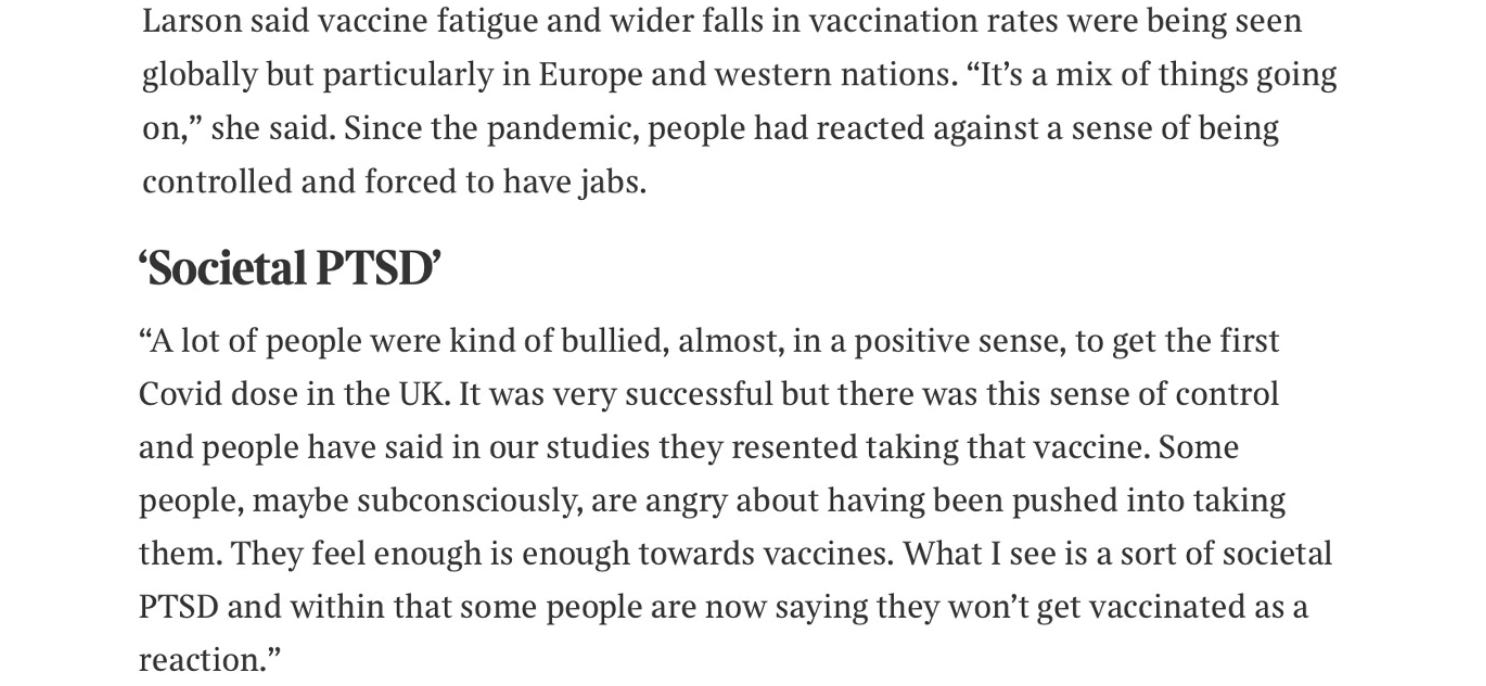
“Bullied, almost, in a positive sense…” is an interesting choice of words. I wonder how much thought Prof Larson has given to informed consent as discussed e.g. in the paper featured in this post:

As to why the vast majority of NHS staff might be refusing flu jabs, Larson cites “toxic information”…
But I wonder how many doctors and nurses would actually say that it was toxic information that was putting them off the flu jab.
And how many would, confidentially at least, cite being coerced, even bullied — and perhaps not “in a positive sense” — into taking the “safe and effective” covid injections.
I suspect that most medics are now at least somewhat aware of what has been going on, even though, despite the duty of candour, few of them seem to be willing to say much about it.
It will be interesting to see what happens following the “Avoidance Stage” of ‘Societal PTSD’…
Related:

Unexpected Turns homepage
The most-read articles can be found here
NB the UK got off relatively lightly, not least thanks to the efforts of the NHS100K discussed in this post:

I was particularly struck by this recent post from US ragtime pianist/satirical songwriter Kylan deGhetaldi (@foundring1):
My kid was kicked out of school and our own church banned her from the premises because she didn’t get a vaccine they now admit isn’t safe for kids to get. They tried to force poison into my kid…
And then there are the statistics on the sharp rise in deaths from 2021 onwards that almost no-one in the public sphere is talking about:

